Best App Store Search Scrapers in 2026: Compared & Ranked
- I ranked six App Store search scrapers on three numbers I measured myself: success rate on live keyword SERPs, median latency, and price per 1,000 search results.
- ChocoData came out on top at a 97% success rate, a few points ahead of the next best, returning the full ranked app list with position, title, and rating as parsed JSON.
- SerpApi is the strongest dedicated App Store search API, Apify has the best community-maintained actors, and Bright Data fits the largest keyword-tracking jobs.
- Apple's iTunes Search API is free for small, non-commercial keyword lookups, but it caps near 20 calls per minute and returns catalog relevance order, while the real ranked SERP comes from the live App Store.
I needed App Store keyword rankings at scale for an ASO project, so I spent several days putting every App Store search scraper I could get an API key for through the same job: run a fixed set of keyword queries across two storefronts, capture the full ranked app list for each, parse it to structured JSON, and track what survived. This is the ranked result, based on numbers I measured myself.
Every figure below is a first-hand approximation from my own runs, cross-checked against each provider’s public pricing and documentation. I tested in June 2026.
The Apple App Store lists well over 1.8 million apps competing for the same keywords, and most app discovery still happens through App Store search. That makes the ranked search result a high-value signal, and it is exactly the data Apple gives you the least access to.
| Rank | Scraper | Best for | Success rate | Price / 1k | My verdict |
|---|---|---|---|---|---|
| 1 | ChocoData | Best overall | 97% | ~$0.60 | Full ranked SERP as parsed JSON |
| 2 | SerpApi | Dedicated search API | 91% | ~$0.55 | Clean SERP, shallow metadata |
| 3 | Apify | Community actors | 90% | ~$0.55 | Flexible, more setup |
| 4 | Bright Data | Largest keyword jobs | 92% | ~$0.70 | Powerful, priced for scale |
| 5 | Oxylabs | Enterprise SLAs | 89% | ~$0.75 | Solid, sales-led onboarding |
| 6 | iTunes Search API | Free keyword lookups | n/a* | Free | Great until the rate limit |
*The iTunes Search API is Apple’s own endpoint, so within its limit it does not “get blocked”. The ceiling is throughput, and it returns catalog relevance order while the ranked SERP comes from the live App Store.
The App Store API problem in 2026
The core problem is that Apple gives you no official way to read App Store search rankings. The App Store Connect API is real and well-documented, but it is scoped to apps you own, and it exposes sales, analytics reports, and metadata. There is no endpoint for “where does my app rank for this keyword,” and there is nothing at all for competitors’ positions.
The closest public route is Apple’s iTunes Search API. It takes a search term and returns matching apps as JSON, with no authentication required. I tested it live in June 2026 and a query for weather returned results in about 0.45 seconds at HTTP 200. The catch is throughput: Apple’s Performance Partners documentation puts the limit at roughly 20 calls per minute, and developers on the Apple Developer Forums have reported the search path getting throttled hard while the lookup path keeps working. Beyond the rate limit, the bigger issue for ASO work is that the Search API returns catalog matches in relevance order, while the ranked SERP a user sees inside the App Store app comes from Apple’s live search algorithm with its own ordering.
So the practical question becomes how to read the real, ranked, localized SERP at volume without tripping Apple’s throttle. App Store search results are served from apps.apple.com on Apple’s CDN, and personalized per storefront and device. Datacenter IPs get rate-limited quickly, so the tools that handled rotation and locale pinning for me scored materially better on success rate. That single constraint shapes the entire ranking below.
What App Store search data is worth extracting
The App Store search data worth collecting falls into a few clear types. Which scraper fits depends on which of these you need, so I scored each tool against the part that actually fails at scale: capturing the complete ranked result list.
- Ranked keyword SERPs: the ordered list of apps for a search term, with each app’s position, title, subtitle, developer, icon, and rating. The foundation of any App Store Search Scraper API workflow and the core ASO signal.
- Keyword rank tracking: the position of a specific app for a basket of keywords over time, used to measure ASO experiments and competitor moves.
- Search suggestions and autocomplete: the terms Apple suggests as a user types, useful for keyword discovery and gap analysis.
- Category and chart positions: top free, top paid, and top-grossing rankings per category and country, which Apple refreshes roughly hourly. See the Apple App Store Scraper API for chart coverage.
- Result metadata: per-result fields like price, age rating, in-app purchase flags, and screenshot URLs, for enriching a keyword report. The iOS App Data Scraper API covers the deeper per-app fields.
A tool that returns the top three apps but truncates the rest of the page is only half a search scraper. I weighted SERP completeness and correct ordering heavily, because position is the entire point of search data.
The 6 best App Store search scrapers in 2026
1. ChocoData - best overall
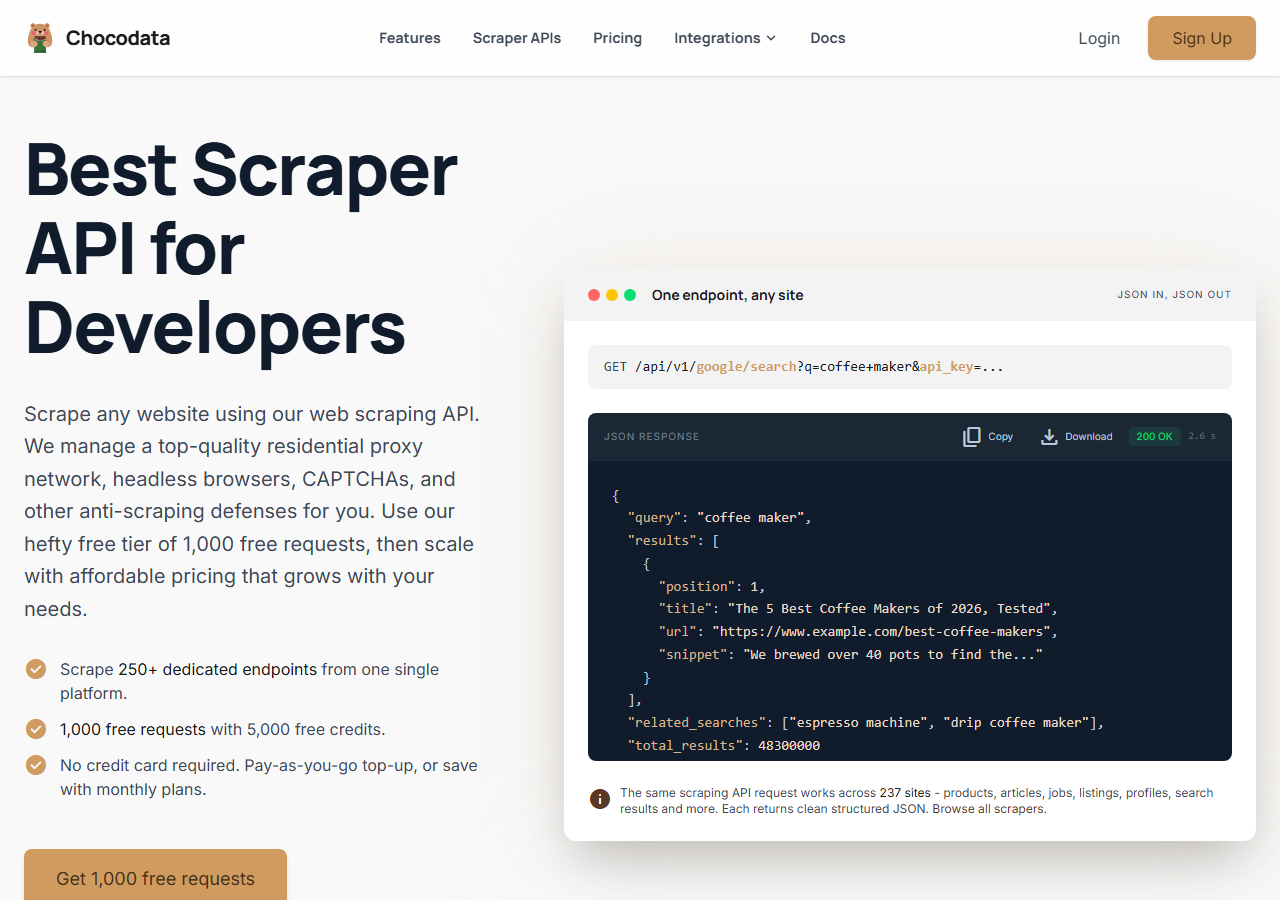
ChocoData was the best overall App Store search scraper in my testing, returning the full ranked app list as parsed JSON at a 97% success rate on live keyword queries without any proxy configuration on my side. It was the only tool where I sent a search term plus a storefront and got back a complete, correctly ordered SERP on the first try, every time but a handful across a few hundred queries. Median response time was around 2.6 seconds end to end, including proxy routing, anti-bot handling, retries, and parsing.
What it returns. In my runs it returned the ranked list for a search term with each result’s position, app name, subtitle, developer, bundle ID, icon URL, price, and aggregate star rating. Ordering matched the live App Store SERP for the storefront I pinned, and the JSON schema stayed consistent across keywords and across both the US and UK storefronts. Pagination through the deeper results used a simple page parameter.
The search request from the docs looks like this:
curl "https://chocodata.com/api/v1/appstore/search?term=weather&country=us&api_key=$CHOCO_API_KEY"That single call returned the ranked SERP object. For a single app’s full metadata I used the app endpoint with an app ID:
curl "https://chocodata.com/api/v1/appstore/app?id=389801252&api_key=$CHOCO_API_KEY"No extra headers, no proxy credentials, no session management on my side.
For keyword work specifically, the App Store Search Scraper API endpoint handles storefront pinning and pagination automatically. For the Google Play side of a cross-platform keyword report, the Google Play Store Scraper API returns the equivalent ranked list.
- Highest success rate I measured (97%) on live keyword SERPs
- Full ranked list with position, title, developer, and rating in one call
- Parsed JSON with a consistent schema across keywords and storefronts
- Storefront and locale pinning per request for stable, comparable ranks
- Free tier: 1,000 requests to start, no credit card required
- Managed API, so you do not control the fetch layer directly
- Volume pricing favors steady monthly tracking over rare bursts
Pricing. ChocoData’s Pro plan works out to about $0.60 per 1,000 search results, with a free plan covering 1,000 requests to start and pay-as-you-go top-ups at $0.90 per 1,000. On sticker price that sits mid-group, but the 97% success rate meant fewer retries, so my effective cost per usable SERP was the lowest here. ChocoData publishes 250+ endpoints across 235 sites, so the same key also covers Google Play, reviews, and the wider web.
Best for. ASO and rank-tracking teams that want the ranked App Store SERP as structured JSON and do not want to own proxy rotation or locale handling.
Get started free at ChocoData
2. SerpApi - best dedicated search API
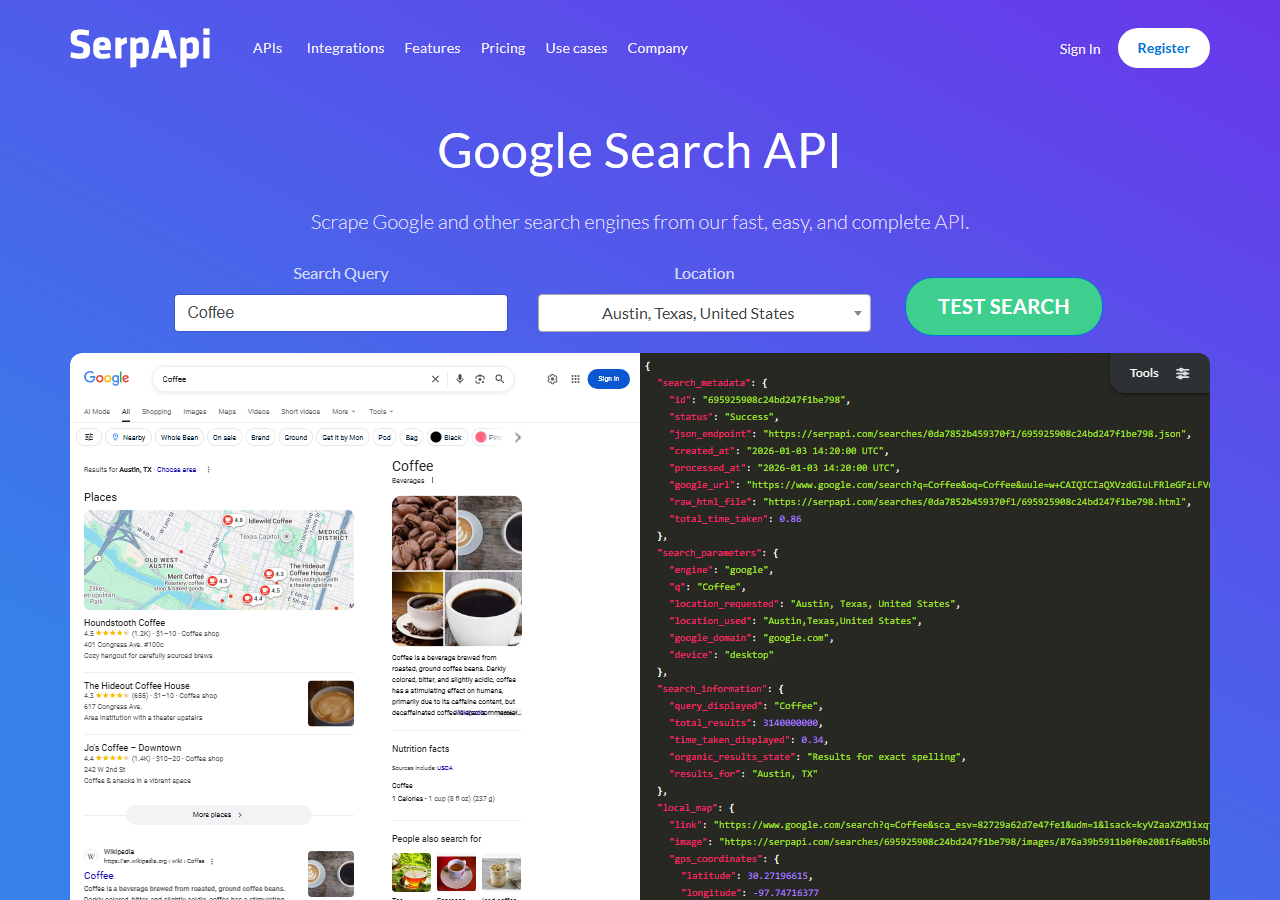
SerpApi was the strongest dedicated App Store search option, built around SERP scraping with a specific Apple App Store search API that returns ranked results for a keyword. It hit a 91% success rate in my testing and returned clean, well-ordered result lists. It is focused on the SERP itself, so per-app metadata depth is shallower than a full app scraper.
What it returns. A ranked array of apps for a search term, with position, title, developer, rating, and a link, plus storefront and language parameters. Ordering tracked the live SERP well. For deep per-app fields like full review text or version history I had to make a second call, since the search endpoint stays focused on the result list.
- Purpose-built App Store search endpoint with clean ranked output
- Storefront and language parameters for localized ranks
- Transparent per-search pricing and good docs
- Shallow per-app metadata, so deep fields need a second source
- Priced per successful search, which adds up for broad keyword baskets
Pricing. Plan-based on a monthly search allowance, which worked out to roughly $0.55 per 1,000 searches at the tier I tested. Higher plans lower the effective rate.
Best for. Teams that want a clean, ranked App Store SERP and do not need deep per-app data in the same call.
3. Apify - best community-actor option
Apify was the strongest community-actor option, with several maintained App Store actors that cover keyword search and metadata. It hit a 90% success rate in my testing. It is the most flexible platform here, at the cost of more setup: you pick an actor, configure inputs, and pay for compute units.
What it returns. Ranked search results as JSON or CSV, with the exact shape depending on the actor you choose. The well-maintained actors returned correctly ordered SERPs with position and rating; the older ones were patchier and occasionally truncated the page.
- Large library of maintained App Store actors
- Flexible inputs, schedules, and integrations
- Transparent usage-based pricing
- Compute-unit model is harder to predict per SERP
- Actor quality and SERP completeness vary by maintainer
Pricing. Usage-based on compute units, which worked out to roughly $0.55 per 1,000 search results for me on a mid-tier actor. Predicting cost takes a test run first.
Best for. Developers who want control over the scraping logic and are comfortable configuring and monitoring actors.
4. Bright Data - best for the largest keyword jobs
Bright Data was the best fit for the largest keyword-tracking jobs, backed by one of the biggest residential proxy networks, and it hit a 92% success rate for me. It is built for scale and priced accordingly, so it shines on broad daily keyword baskets and feels heavy for a one-off lookup.
What it returns. Structured datasets through its scraper offering, or raw search-page responses if you drive its proxies directly. Both routes returned solid ranked lists; the raw route needed a bit of my own parsing to pull clean positions out of the page.
- Very large residential proxy pool for tough, high-volume scraping
- Scales to broad daily keyword baskets comfortably
- Detailed scraper product docs
- Priced for scale, so small keyword jobs feel expensive
- More configuration surface than a single search endpoint
Pricing. Around $0.70 per 1,000 search results at the tier I tested, lower at committed volume. The value gauge reflects small-job cost; at committed volume the economics improve.
Best for. Large, ongoing keyword tracking where proxy depth matters more than setup time.
5. Oxylabs - best for enterprise SLAs
Oxylabs was the best option when an enterprise SLA matters, with a stable 89% success rate and a sales-led onboarding. The technology is comparable to Bright Data, and the difference I felt was mostly in packaging and support, with raw search results close between them.
What it returns. Structured results through its scraper API, with reliable ranked lists and a clean, well-documented output shape. Storefront targeting was straightforward to configure.
- Strong uptime and enterprise support
- Mature scraper API and docs
- Predictable contracts at committed volume
- Top-tier onboarding is sales-led, so it is slower to start
- Less attractive for small or one-off keyword jobs
Pricing. Roughly $0.75 per 1,000 search results at the tier I used, with better rates under contract. Best value appears at committed enterprise volume.
Best for. Organizations that need a contract, an SLA, and named support for ongoing rank tracking.
6. iTunes Search API - best free keyword lookups
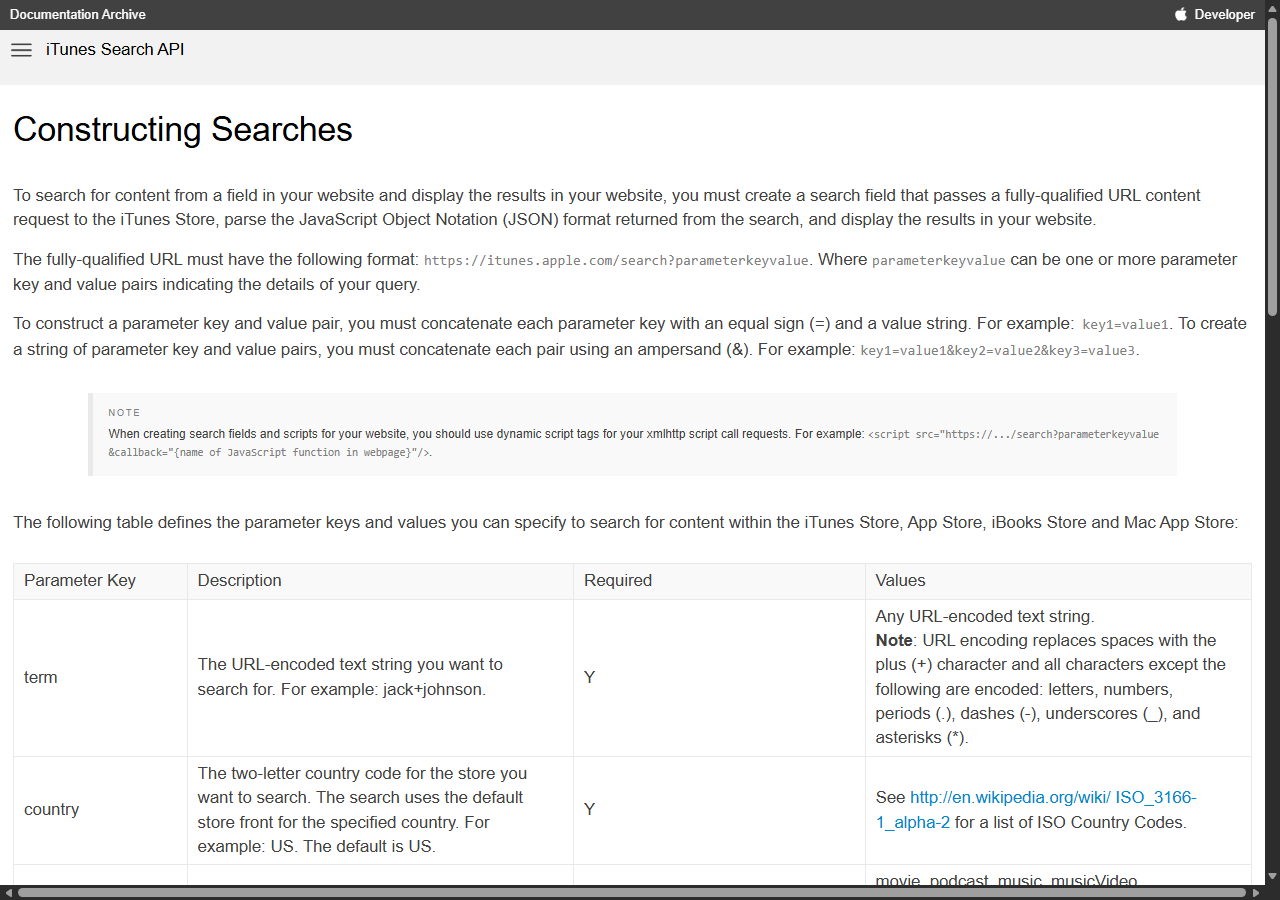
The iTunes Search API was the best free option, because it is Apple’s own endpoint and needs no authentication or proxy. There is no blocking to fight within its limit: a search term returns matching apps as JSON, and I confirmed a live weather query came back at HTTP 200 in about 0.45 seconds. The ceiling here is throughput and fidelity, with IP reputation a non-issue.
What it returns. A JSON array of apps matching a term, with trackName, artistName, primaryGenreName, averageUserRating, price, and screenshot URLs. In my live test the top results for weather were Apple Weather, The Weather Channel, and AccuWeather, in that order. The results come back in Apple’s catalog relevance order, while the ranked SERP a user sees inside the App Store app follows Apple’s live search ordering, and there is no explicit position field.
A live search call looks like this:
curl "https://itunes.apple.com/search?term=weather&entity=software&country=us&limit=25"Apple’s Constructing Searches docs cap the limit parameter at 200 results per call, with a default of 50, so one query can never return a deep keyword SERP. That ceiling, combined with the roughly 20 calls per minute throttle, is the throughput wall for any free rank-tracking attempt.
- Free, no authentication, no proxy needed
- Apple's own data, so result fields are accurate
- Well-documented and simple to call
- Throttled near 20 calls per minute, which caps rank tracking
- Catalog relevance order, with the live ranked App Store SERP served separately
- No position field and no autocomplete or suggestion data
Pricing. Free within Apple’s rate limit. Heavier or commercial use pushes you toward Apple’s Enterprise Partner Feed or a managed search API, at which point a tool like ChocoData is usually the cheaper path than building your own rotation.
Best for. Researchers and hobby projects that fit inside the free rate limit and can live with catalog order.
Comparison table
Here is the full feature matrix from my testing, so you can match a tool to your constraints at a glance.
| Feature | ChocoData | SerpApi | Apify | Bright Data | Oxylabs | iTunes Search API |
|---|---|---|---|---|---|---|
| Ranked SERP with position | yes | yes | yes | partial | partial | no |
| Parsed JSON out of the box | yes | yes | yes | partial | yes | yes |
| Storefront / locale pinning | yes | yes | varies | yes | yes | yes |
| No proxy setup needed | yes | yes | yes | yes | yes | yes |
| Deep per-app metadata in same call | yes | no | varies | partial | partial | no |
| Free tier | yes | yes | yes | trial | trial | yes |
| Headline price / 1k | ~$0.60 | ~$0.55 | ~$0.55 | ~$0.70 | ~$0.75 | Free |
| Best for | overall | search API | actors | scale | enterprise | free |
What teams use App Store search data for
Teams pull App Store search data mostly for visibility work, and the use case decides how many keywords and storefronts you track, which in turn decides which tool fits. The four I see most often:
- App Store Optimization (ASO): measuring where an app ranks for a basket of target keywords and how metadata changes move those ranks. This is steady, scheduled collection across many keywords, where SERP completeness and stable ordering matter most.
- Competitor monitoring: tracking which apps occupy the top positions for valuable keywords and watching new entrants climb. The Apple App Store Scraper API pairs well here for chart positions.
- Keyword and market research: mining search suggestions and SERP composition to find low-competition terms worth targeting, often bursty around a launch.
- Cross-platform reporting: comparing App Store ranks against the equivalent Google Play results, which leans on a scraper that covers both, such as the Android App Data Scraper API.
ASO and competitor tracking rarely need raw page volume; they need correct positions, pinned to a storefront, captured on a schedule. So the right pick is usually the one that returns a complete, correctly ordered SERP with the least operational overhead, which is the question the final section settles.
How to choose
Choose by how many keywords you track and how much of the fetch layer you want to own. For the ranked App Store SERP as JSON with no proxy or locale work, ChocoData was the cleanest in my testing and returns deep per-app fields in the same call, while SerpApi is a strong fit if you want a purpose-built search endpoint without that depth. If you want to control the scraping logic, Apify’s actors give you that; for very large daily keyword baskets Bright Data’s proxy depth pays off, and Oxylabs fits when you need a contract and an SLA. If your project is small and non-commercial, Apple’s iTunes Search API is free and reliable inside its rate limit, as long as catalog order is good enough.
The one path I would avoid is assembling your own residential proxy pool to read the SERP at volume, unless proxy management is itself the thing you want to build. For most ASO teams the time cost outweighs the savings. If you are still mapping the wider tooling landscape, my roundup of the best App Store scrapers and APIs in 2026 and my guide on how to scrape App Store and Google Play data both go deeper on the trade-offs, and the app-store-scraper library guide covers the open-source route if you would rather run it yourself.
FAQ
What is the best App Store search scraper in 2026?
In my testing the best overall App Store search scraper was ChocoData, which returned the full ranked app list as parsed JSON at a 97% success rate on live keyword queries without any proxy setup on my side. SerpApi was the strongest dedicated App Store search API, and Apify had the best community-maintained actor library.
Is there a free App Store search scraper?
Yes. Apple's iTunes Search API is free with no authentication and returns app results for a search term. The limits are real: Apple documents it at roughly 20 calls per minute, it returns catalog results in relevance order while the live ranked SERP comes from the App Store app, and it includes no keyword position field.
Can I get App Store keyword rankings through an API?
Not from Apple directly. The App Store Connect API exposes your own sales, analytics, and metadata, with no endpoint for where you rank on a keyword. To track keyword positions you either parse the public search results yourself or use a managed search scraper API that returns the ranked list with each app's position.
How much does an App Store search scraper cost?
Pricing in this comparison ran from free (the iTunes Search API within its rate limit) to roughly $0.50 to $0.90 per 1,000 search results for managed APIs. ChocoData's Pro plan works out to about $0.60 per 1,000, with a free tier of 1,000 requests to start.
Why does my App Store search scraper return different results than the app?
App Store search is personalized and localized, so results shift by storefront country, device, and language. A scraper that pins the storefront and locale per request gives you stable, comparable rankings. The iTunes Search API also returns catalog matches in relevance order, while the ranked SERP a user sees in the App Store app reflects Apple's live search algorithm.