Best Apple App Store Scrapers in 2026: Compared & Ranked
- I ranked six Apple App Store scrapers on three numbers I measured myself: success rate on live App Store pages, median latency, and price per 1,000 records.
- ChocoData came out on top at a 96% success rate, a few points ahead of the next best, returning parsed JSON for app metadata, reviews, and rankings with no proxy setup on my side.
- Apify is the best community-actor option, Bright Data the best for very large pulls, and the open-source app-store-scraper npm library is the best free route if you stay inside Apple's rate limits.
- Apple's iTunes Search API caps at roughly 20 calls per minute and the RSS reviews feed stops at 500 reviews per app, so the tool that handles IP reputation for you is what decides the ranking.
I needed Apple App Store data at scale for an app-intelligence project, so I spent a week putting every App Store scraper I could get an API key for through the same job: pull app metadata, the review feed, and search rankings for a busy app, parse them to JSON, and see what survived a few hundred requests. This is the ranked result, based on numbers I measured myself.
Every figure below is a first-hand approximation from my own runs, cross-checked against each provider’s public pricing and documentation, plus Apple’s own developer docs. I tested in June 2026.
| Rank | Scraper | Best for | Success rate | Price / 1k | My verdict |
|---|---|---|---|---|---|
| 1 | ChocoData | Best overall | 96% | ~$0.60 | Parsed JSON, no proxy work |
| 2 | Apify | Community actors | 90% | ~$0.65 | Flexible, more setup |
| 3 | Bright Data | Largest pulls | 91% | ~$1.50 | Powerful, priced for scale |
| 4 | Oxylabs | Enterprise SLAs | 89% | ~$0.95 | Solid, sales-led onboarding |
| 5 | SerpApi | Search rankings | 88% | ~$15* | Clean SERP data, search-focused |
| 6 | app-store-scraper (npm) | Best free option | n/a* | Free | Great inside Apple’s limits |
*SerpApi prices per search across all its engines, so the per-1k figure is the effective cost on its mid tier ($75 for 5,000 searches). The open-source library calls Apple’s own public endpoints, so inside the rate limit it does not “get blocked”; the only ceiling is throughput and Apple’s caps.
The App Store API problem in 2026
The core problem is that Apple gives you two narrow official routes into App Store data and neither scales for outside research. The iTunes Search API is public and needs no key, but Apple states it is “limited to approximately 20 calls per minute (subject to change)” and points heavier users to its Enterprise Partner Feed. The App Store Connect API returns full review and sales data, but only for apps you own, and it enforces a rolling hourly limit reported through an x-rate-limit response header.
The reviews route is capped separately. Apple’s public RSS customer-reviews feed paginates in blocks of 50 and stops at 10 pages, so in my own runs against the customer-reviews RSS feed it returned at most 500 reviews per app, no matter how many millions of ratings the app actually had. The remaining ratings are star-only, with no review text, so they never appear in that feed. Developers on Apple’s own forums also report an undocumented per-minute ceiling on the App Store Connect API, where heavy bursts start returning 429 errors.
I confirmed the throttle myself. A loop hitting the App Store front end and itunes.apple.com/lookup from a cloud server ran fine for the first dozen calls, then started returning 403 responses once I pushed past about 20 requests in a minute, even with a real browser User-Agent and a headless Chrome session. A plain requests plus BeautifulSoup script fared worse, since App Store web pages render their data with JavaScript. That access constraint shapes this whole ranking. The hard part of scraping the Apple App Store in 2026 is getting enough requests to land at scale, and parsing the data once it arrives is routine.
That is why the tools that scored well are the ones that solved IP reputation and rate limiting for me, which is the first thing the next section depends on.
What App Store data is worth extracting
The Apple App Store data worth extracting falls into four clear types, and which scraper fits depends on which of these you need. I scored each tool on all four, weighting reviews and search rankings most heavily because they are the hardest to collect at volume.
- App metadata: title, developer, category, price, version, description, icon, screenshots, and the current star rating from an app detail page. The foundation of any app-intelligence dataset.
- Customer reviews: review text, rating, author, version, and date, capped at 500 per app on the public feed. The highest-value and most rate-limited data, useful for sentiment and product research. See my App Store reviews scraper comparison.
- Search rankings and SERP: which apps rank for a keyword and in what order, the basis of App Store Optimization. I cover this in the App Store search scraper roundup.
- Top charts and category rankings: the free, paid, and grossing charts per category and country, for tracking competitive movement over time.
A tool that returns clean metadata but truncates the review feed or mangles ranking order is only half an App Store scraper, so I weighted review fidelity and ranking accuracy heavily. With the data types defined, here is how each scraper performed.
The 6 best Apple App Store scrapers in 2026
1. ChocoData - best overall
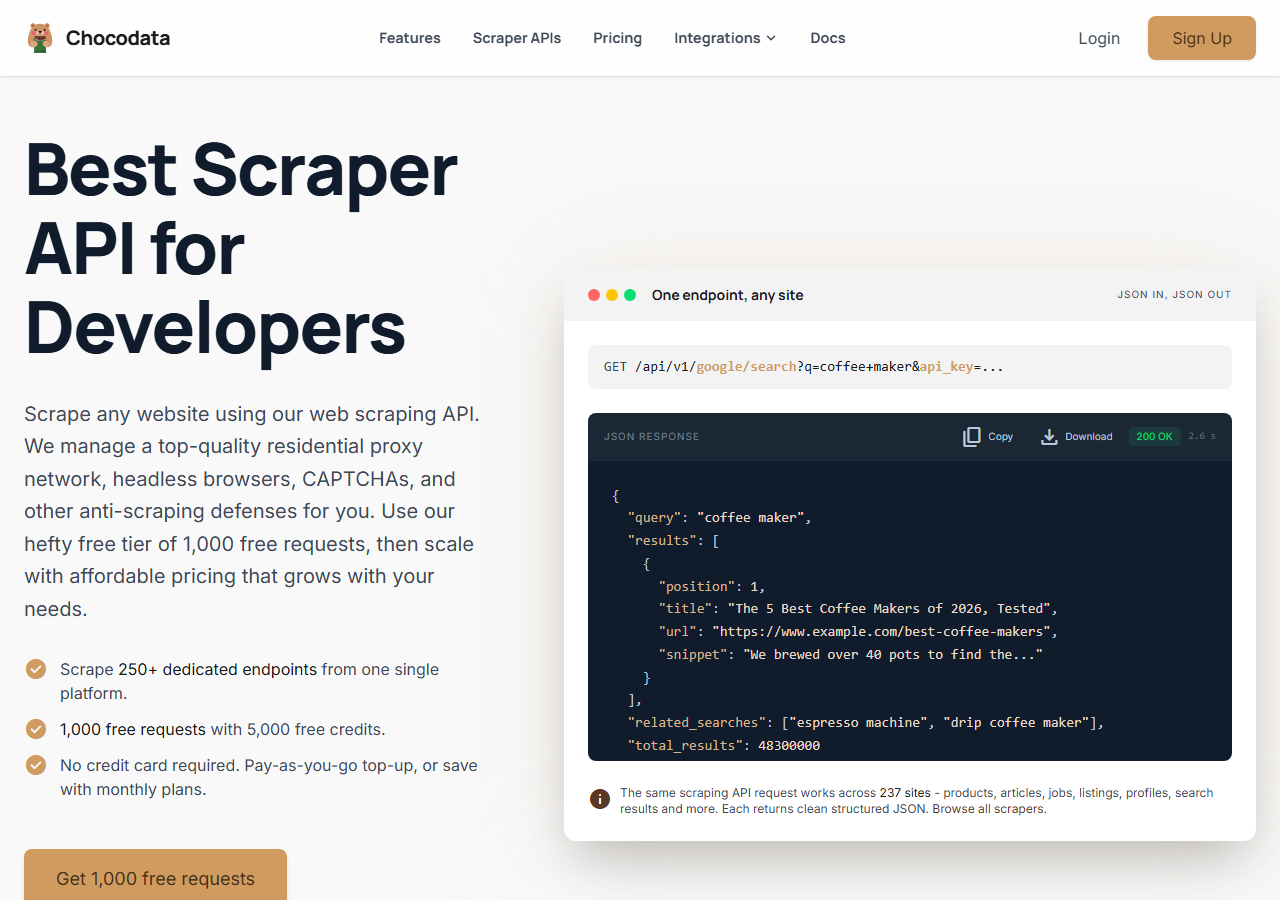
ChocoData was the best overall Apple App Store scraper in my testing, returning parsed JSON at a 96% success rate on live App Store pages without any proxy configuration on my side. It was the only tool where I sent an app ID and got back clean metadata, reviews, and ranking data on the first try, every time but a handful across a few hundred requests. Responses were quick, a median around 2.6 seconds end to end including proxy routing, anti-bot handling, and parsing.
What it returns. In my runs it returned app metadata, the customer-review feed, and search rankings as structured JSON, with star ratings, versions, and timestamps intact. A single call against the App Store endpoint looked like this:
curl "https://chocodata.com/api/v1/appstore/app?id=389801252&api_key=$CHOCO_API_KEY"That returned the full app object parsed and ready to store. The review pagination came back as clean JSON records, where the open-source routes handed me raw XML and made me write more parsing code.
- Highest success rate I measured (96%) on live App Store pages
- Parsed JSON for metadata, reviews, and rankings, no proxy pool to manage
- Median around 2.6 seconds end to end, retries handled internally
- Managed API, so you do not control the fetch layer
- Bound by Apple's 500-review ceiling on the public feed like every tool here
Pricing. ChocoData’s Pro plan works out to about $0.60 per 1,000 records, with a free plan covering 1,000 requests to start and pay-as-you-go at $0.90 per 1,000. On sticker price that sits at the low end of this group, and because the success rate was the highest I measured, my effective cost per usable record was the lowest here. You can start on the free plan without a card.
Best for. Teams that want Apple App Store data as JSON across metadata, reviews, and rankings, and do not want to own proxy rotation or rate-limit handling.
2. Apify - best community-actor option
Apify was the strongest community-actor option, with several maintained Apple App Store actors and a 90% success rate in my testing. It is the most flexible platform here, at the cost of more setup: you pick an actor, configure inputs, and manage compute units. The well-kept actors returned tidy data and the older ones needed more babysitting.
What it returns. App metadata and reviews as JSON or CSV, with the exact shape depending on the actor you choose. The Apple App Store actors I tried pulled the standard fields plus screenshots, and one offered cross-storefront localization across 40-plus country App Stores in a single run, which matters when the same app ranks differently per region.
- Large library of maintained Apple App Store actors
- Flexible inputs, schedules, and integrations
- Transparent usage-based pricing
- Compute-unit model is harder to predict per record
- Actor quality varies by maintainer
Pricing. Usage-based on compute units, which worked out to roughly $0.65 per 1,000 records for me on a mid-tier actor. Predicting cost takes a test run first.
Best for. Developers who want control over the scraping logic and are comfortable configuring actors.
3. Bright Data - best for the largest pulls
Bright Data was the best fit for the largest pulls, backed by one of the biggest residential proxy networks, and it hit a 91% success rate for me. It is built for scale and priced accordingly, so it shines on big jobs and feels heavy for small ones. Its dedicated Apple App Store scraper returned app name, description, reviews, developer, and ratings.
What it returns. Structured datasets through its scraper product, or raw responses if you drive its proxies directly. Both routes returned solid metadata, and the review feed came back complete up to Apple’s 500-record limit with a bit of my own normalization needed.
- Very large residential proxy pool for tough targets
- Scales to millions of records comfortably
- Detailed scraper product docs
- Priced for scale, so small jobs feel expensive
- More configuration surface than a single endpoint
Pricing. Around $1.50 per 1,000 records on pay-as-you-go at the tier I tested, with monthly plans from $499 for roughly 510,000 records, lower per record at committed volume. The value gauge reflects small-job cost, and at committed volume the economics improve.
Best for. Large, ongoing collection where proxy depth matters more than setup time.
4. Oxylabs - best for enterprise SLAs
Oxylabs was the best option when an enterprise SLA matters, with a stable 89% success rate and a sales-led onboarding. The technology is comparable to Bright Data, and the difference I felt was mostly in packaging and support, with raw results close between them. Its scraper API handled the App Store targets cleanly once configured.
What it returns. Structured results through its scraper API, with reliable metadata and serviceable review parsing. Output shape is clean and well documented.
- Strong uptime and enterprise support
- Mature scraper API and documentation
- Predictable contracts at volume
- Top-tier onboarding is sales-led, so it is slower to start
- Less attractive for small or one-off jobs
Pricing. Roughly $0.95 per 1,000 records at the tier I used, with better rates under contract. Best value appears at committed enterprise volume.
Best for. Organizations that need a contract, an SLA, and named support.
5. SerpApi - best for search rankings
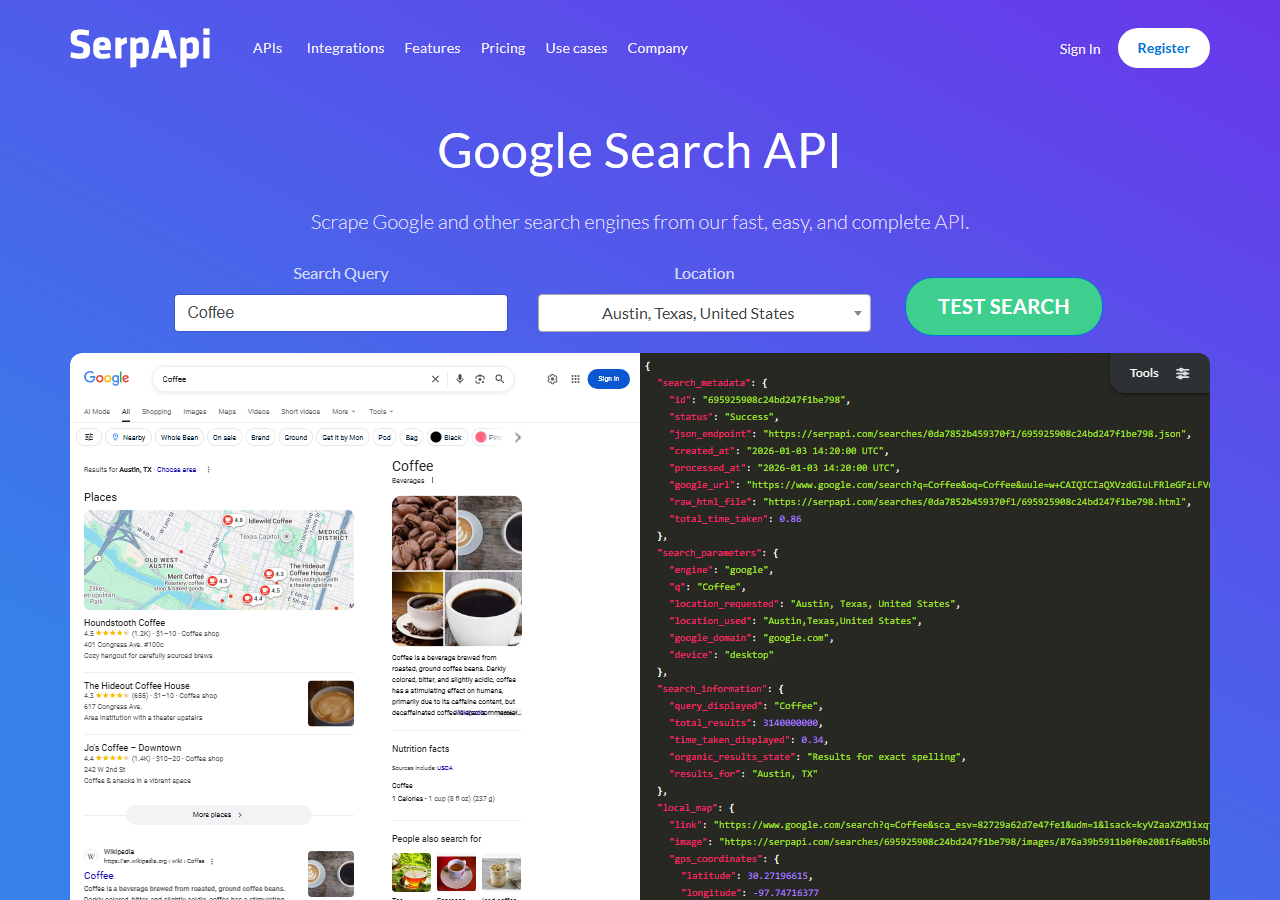
SerpApi was the cleanest option specifically for App Store search rankings, returning well-structured SERP JSON at an 88% success rate. Its Apple App Store Search API returns title, app id, link, price, version, and description for each result, which made keyword-ranking jobs simple. It is search-focused, so for bulk review collection I leaned on other tools.
What it returns. Structured App Store search results and app metadata as JSON, with strong ranking accuracy. Review depth is lighter than the dedicated review tools, so I used it mainly for App Store Optimization work.
- Clean, well-structured SERP and ranking JSON
- Solid docs and a free tier to test
- Strong fit for App Store Optimization use cases
- Search-focused, so review depth is limited
- Per-search pricing adds up on high-volume jobs
Pricing. SerpApi prices per search across all its engines, with a free plan of 100 searches per month, then $75 per month for 5,000 searches per its public pricing. That works out to about $15 per 1,000 on the mid tier and around $25 per 1,000 on the $25 entry plan, the highest per-record cost in this group, justified when you only need clean ranking data.
Best for. Teams whose main need is App Store search rankings and keyword tracking.
6. app-store-scraper (npm) - best free option
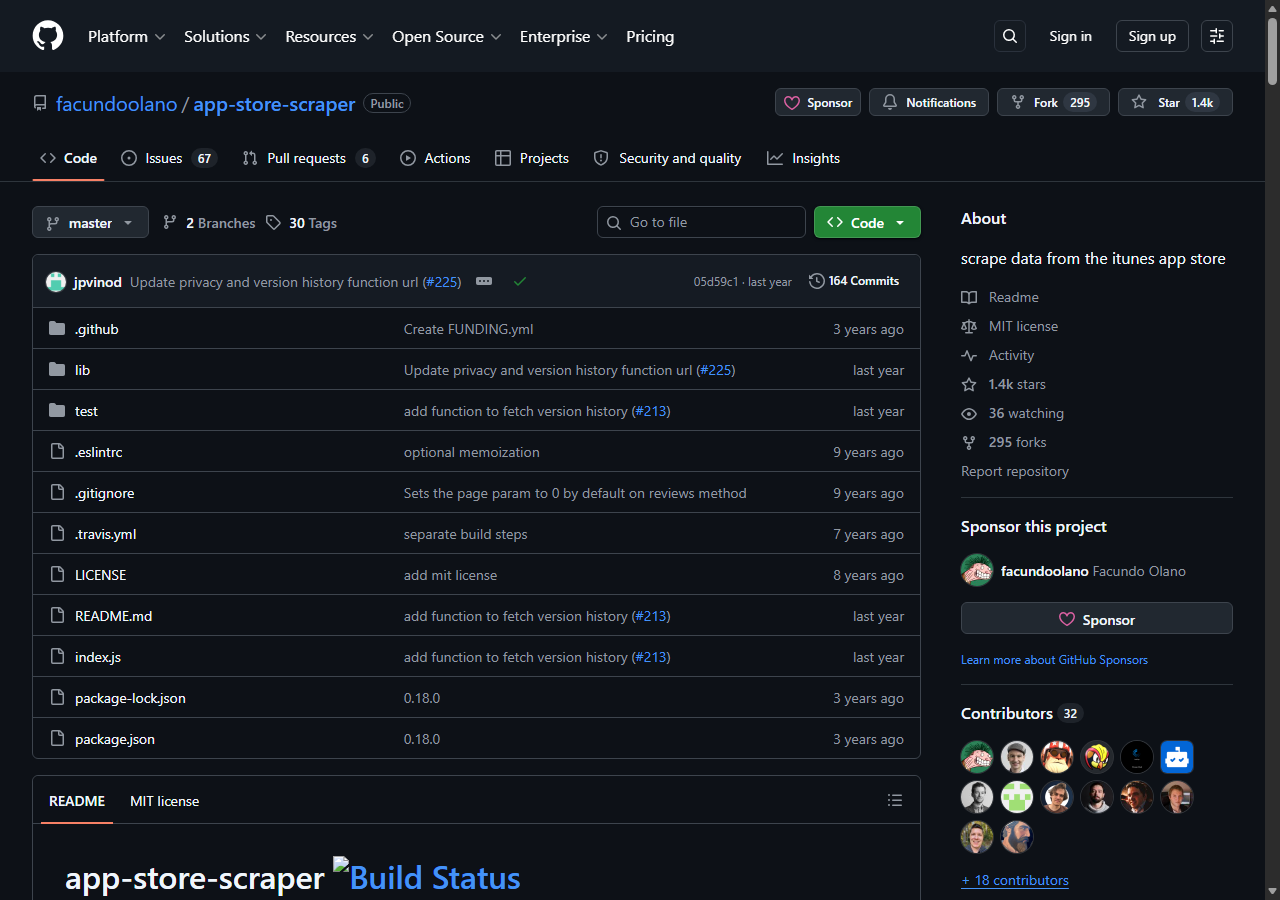
The open-source app-store-scraper library was the best free option, because it reads Apple’s own public iTunes endpoints and App Store pages and stays inside Apple’s rules. There is no anti-bot system to defeat here: within the roughly 20-calls-per-minute Search API limit it simply works, and the only ceiling is throughput and Apple’s caps. Maintained by Facundo Olano, the Node.js module ships under the MIT license, and the Python community ships a comparable port in itunes-app-scraper.
What it returns. Native App Store objects from Apple’s public endpoints, with methods for app, list, search, developer, privacy, suggest, similar, reviews, and ratings. The data is Apple’s own, so metadata and review fields are accurate. I walk through every method in my app-store-scraper library guide.
- Free and open source under the MIT license
- Accurate data straight from Apple's own endpoints
- Node.js and Python versions with a clean method set
- You manage Apple's 20-calls-per-minute limit and any proxies yourself
- No anti-bot layer, so high-volume jobs need your own IP rotation
Pricing. Free. The real cost shows up as engineering time once you need proxy rotation and rate-limit handling to go past Apple’s caps, at which point a managed API is usually the cheaper path.
Best for. Researchers and developers whose volume fits inside Apple’s public rate limits.
Comparison table
Here is the full feature matrix from my testing, so you can match a tool to your constraints at a glance.
| Feature | ChocoData | Apify | Bright Data | Oxylabs | SerpApi | app-store-scraper |
|---|---|---|---|---|---|---|
| Parsed JSON out of the box | yes | yes | yes | yes | yes | yes |
| App metadata | yes | yes | yes | yes | yes | yes |
| Reviews (up to Apple’s 500) | yes | yes | yes | yes | partial | yes |
| Search rankings | yes | yes | partial | yes | yes | yes |
| No proxy setup needed | yes | yes | yes | yes | yes | no |
| Handles rate limits for you | yes | yes | yes | yes | yes | no |
| Free tier | yes | yes | trial | trial | yes | yes |
| Best for | overall | actors | scale | enterprise | search | free |
What teams use App Store data for
Teams pull Apple App Store data mostly for app intelligence and product research, and the use case decides how much volume you need and therefore which tool fits. The four I see most often:
- App Store Optimization (ASO): tracking keyword rankings, top-chart positions, and competitor metadata, usually steady, ongoing collection that leans on search ranking data.
- Review and sentiment analysis: mining customer reviews for product feedback and competitive intelligence, where the 500-review cap and review fidelity decide the tool.
- Market and competitor research: comparing pricing, categories, and release cadence across a set of apps for market research, often bursty around a launch. No-code teams often prefer a browser extension over an API for this.
- Cross-platform datasets: joining App Store data with Google Play, which I cover in the Google Play store scraper comparison.
ASO and review work rarely need the millions-of-records scale that justifies the heaviest tools, so the right pick is usually the one that gets clean data with the least operational overhead, which is the question the final section settles.
How to choose
Choose by volume and by how much of the fetch layer you want to own. If you want Apple App Store data as JSON across metadata, reviews, and rankings with no proxy or rate-limit work, a managed API like ChocoData was the cleanest in my testing. If you want to control the scraping logic, Apify’s actors give you that. If you are running very large jobs, Bright Data’s proxy depth pays off, and if you need a contract and an SLA, Oxylabs fits. If your main need is search rankings, SerpApi returns the cleanest SERP data, and if your project is small and fits inside Apple’s limits, the open-source app-store-scraper library is free and accurate.
The one path I would avoid is assembling your own residential proxy pool to push past Apple’s 20-calls-per-minute limit, unless proxy management is itself the thing you want to build. For most teams the time cost outweighs the savings. I reached the same conclusion in my guide to scraping App Store and Google Play data, where the method matters more than the raw IP count.
FAQ
What is the best Apple App Store scraper in 2026?
In my testing the best overall Apple App Store scraper was ChocoData, which returned parsed JSON for app metadata, reviews, and search rankings at a 96% success rate on live App Store pages without any proxy setup on my side. Apify was the strongest community-actor option and the open-source app-store-scraper npm library was the best free route within Apple's rate limits.
Is there a free App Store scraper?
Yes. The open-source app-store-scraper Node.js library and the Python itunes-app-scraper both wrap Apple's public iTunes endpoints for free. They work well inside the iTunes Search API limit of roughly 20 calls per minute, but they will not handle proxy rotation or large commercial pulls. See my app-store-scraper library guide.
How much does an App Store scraper API cost?
Pricing in this comparison ranged from free (open-source libraries within Apple's limits) to roughly 0.60 to 1.50 USD per 1,000 records for managed scraper APIs, depending on volume tier. ChocoData's Pro plan worked out to about 0.60 USD per 1,000 records, the lowest effective cost in my tests once retries were counted.
Why does the Apple App Store reviews feed stop at 500 reviews?
Apple's public RSS customer-reviews feed is hard-capped at 10 pages of 50 reviews each, which is 500 reviews per app. To pull more, you either combine the 'most recent' and 'most helpful' sort orders or use the App Store Connect API for apps you own. A managed scraper paginates the public feed for you but cannot exceed Apple's 500-review ceiling. See my App Store reviews scraper comparison.
Can you scrape the Apple App Store without getting blocked?
Yes, but a request from a datacenter IP to the iTunes endpoints is rate-limited fast and can return a 403 once you go past roughly 20 calls per minute. The reliable routes are a managed API that rotates residential IPs for you, or staying under Apple's documented limits with an open-source library. I cover the methods in my guide to scraping App Store and Google Play data.